

When selecting a 3D inspection system, it’s important to look at the specifications, performance and cost of the sensors. These factors, however, shouldn’t be the sole focus of your attention. You should also be aware of the “hidden” complexity and cost of cables, networking, controllers/software and external communications.
Standard Multi-Sensor Solutions: Complex and Costly
System complexity is particularly critical when considering inspection systems that require multiple sensors to cover a large field-of-view with high resolution, or to inspect objects from multiple angles.
Multiple sensor systems require a means of synchronization at the microsecond level to ensure that all sensor data is stitched precisely into a single 3D point cloud representing the target object.
In such systems, consideration must be given to the number of components required to integrate the sensors. Many 3D sensors require a separate image processing controller for each sensor, or some need a controller for each pair of sensors.
For large systems with a multitude of sensors, external controllers add significant acquisition cost and increase complexity of integration.
In addition, 3D sensors must to be able to communicate data to the facility’s control system such as a PLC (Programmable Logic Controller). Different PLCs use different languages (Modbus TCP, EtherNet/IP™, custom ASCII strings), so it’s important to make sure that the inspection device has the right connectivity option to communicate with it. If the sensors are not capable of communicating directly with the PLC, you will need to purchase a hardware module, which acts as a translator between the two systems.
Interconnecting cables for inputs, outputs, and power can add even more cost and complexity, particularly if multiple components are required in sensor implementation. If several sensors are needed for an application, this complexity can again be multiplied.
In the end, simplified cabling is preferred in multi-sensor systems because when an inspection solution requires a complicated setup of cables it leads to unstable connections, ultimately requiring more maintenance during the system’s lifecycle due to the additional componentry.
All-in-One 3D Smart Sensors: Eliminating Hidden Cost and Complexity
Implementing multiple 3D sensors into a system doesn’t have to be complicated. To simplify implementation and minimize cost, you should consider smart, all-in-one 3D sensors with image processing and networking capability included inside the sensor itself.
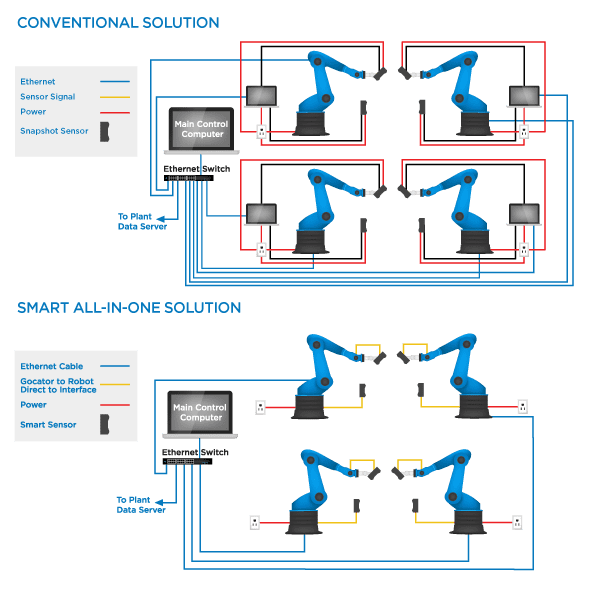
These network savvy, all-in-one devices form the backbone of future smart factories, powering the use of robot handling and increased automation. As networked sensors they are able to connect with factory infrastructure to report results, web browsers for diagnostics and monitoring, the Internet for upgrades, and even with other sensors to exchange or combine data.

3D smart sensors also offer a web-browser driven point-and-click environment for rapid configuration, built-in measurement and rich I/O for communicating results. And, their compact, industrial housing and simple cordset offer long cable runs and support easy mounting into factory machinery.